

Where do I stay on a locum tenens assignment?
December 15, 2025
When you take a locum tenens assignment, your goal is to integrate seamlessly into your work environment—so why should your home environment be any different? A good agency should make creating that temporary home-away-from-home easy for you. Most locums agencies, like Global Medical Staffing, handle all your housing arrangements, taking the burden off you. Whether you’re heading to a new assignment solo or relocating your whole family, you’ll have a place to stay, and most importantly, somewhere to call home.
The best part? There are options, and understanding those options and how to communicate your needs can make the difference between an inconvenient crash pad and the true comforts of a place that feels like your own.
What kind of housing should I expect on a locum tenens assignment?
Where you stay will largely depend on the length of your locums assignment. A longer assignment generally will land you in more of a permanent living environment, rather than a hotel.
If your locums assignment is shorter, such as a few weeks to a month, you’re more likely to stay in an extended-stay hotel or vacation rental with a kitchenette. It’ll be cozy and understandably short-term.
If you do end up staying for a few months or longer, you can typically expect a modestly furnished one-bedroom, one-bath apartment. Upgrades are available for large families, pets, or personal preference.
In certain cases, some facilities, especially internationally, may offer housing exclusively for locum providers. Dr. Dalilah Restrepo, an infectious disease physician working in New Zealand, described the housing provided directly through her hospital, which was so close that she could walk to work.
"It was very comfortable," she says. “We took our son with us to New Zealand. It was fun to live the experience together as a family, and our housing made it feel like home.”
How do I communicate my housing needs for a locum tenens assignment?
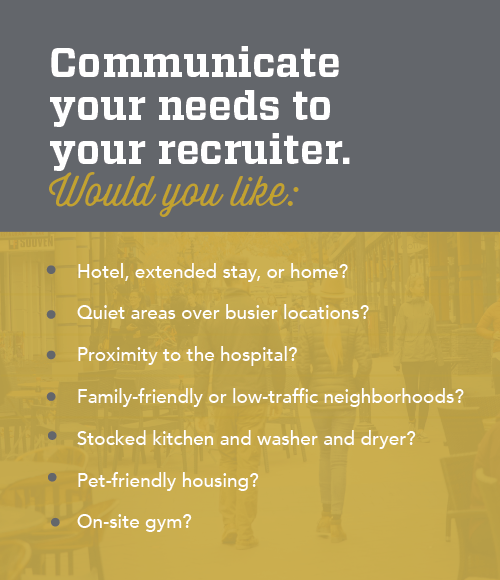
Once you’ve accepted an assignment, you need to share everything: your needs, your wants, your nice-to-haves, and who you’re bringing. It is essential because the more you communicate up front, the likelier it is for the agency to meet your needs. Remember, if you don’t ask, you may end up in less-than-ideal housing.
Here’s a clear, practical list of what locum physicians should communicate to their recruiters about housing preferences to ensure placements run smoothly and comfortably:
Key housing preferences locums should communicate
Things to consider for locums housing:
Location: Do you want to be close to the hospital or clinic or in a walkable downtown area?
Physical needs: Do you need an elevator, no stairs, or ground-floor access?
Amenities: Is a gym or washer/dryer in the unit non-negotiable? King-size bed? TV in the bedroom?
Workspace: Do you need a quiet place to chart or take calls?
Dr. Penny Williams, who worked a locums assignment in St. Croix, shared:

I stayed in a cute little apartment just outside of town, a short drive to the hospital. It had everything I needed, and it felt like home.
Home is a state of mind; for others, it might include your family and/or pets. That's vital information to share. Most agencies can accommodate these requests; however, additional costs, such as larger spaces or pet deposits, may be your responsibility.
Why you should work with Global Medical Staffing: Learn the 4 key benefits
Can you upgrade?
Most assignment contracts cover the cost of a furnished one-bedroom, one-bath unit. However, if you're looking for something larger or pet-friendly, you may need to pay extra for the upgrade.
This includes upgrades such as extra bedrooms or bathrooms, premium amenities (e.g., pool, private balcony, in-unit laundry), additional furnishings (like a second TV or workspace), and pet fees or deposits, among others.
The comforts of home may not always be included in the contract, but that doesn’t mean you have to live deprived. Know what will make or break the experience for you, and go in with an open mind.
Dr. Jason Heine, who worked a year-long locums assignment in New Zealand, bringing his wife and children, shared:

Housing was family-friendly—nothing extravagant but comfortable.
Agencies can also assist in finding pet-friendly housing, but breed restrictions and additional cleaning fees may apply. Whatever your needs, open communication upfront is the best way to make sure your new home is the right fit.
Want to book your own housing?
Some doctors may prefer to arrange their own housing. This provides both added control and a creative way to use the stipend afforded to you. In that case:

Your agency may reimburse you or offer a housing stipend

You may need to provide receipts and proof of reasonable costs

Booking your housing requires a lot of preplanning and research
The bottom line: The earlier you communicate your housing needs, the better your experience will be. From accessibility requests to pet accommodations and family logistics, nothing is too small to mention. Agencies can’t meet any of the expectations they don’t know about—so speak up early, be specific, and advocate for what will make your assignment feel like home. If that means finding your own housing, then plan for that too.
Want to learn more about how locums actually work? Check out our locum tenens resources
How do I know my locum tenens housing will be safe and reliable?
Don’t be afraid to ask about safety, quality, and prior use. Be direct with your questions: Has this property been used by other providers? Were there any complaints or issues?
Your agency is well-positioned to provide reviews from previous locum tenens providers, photos and videos of the property, and the option to stay in a hotel before committing to any one accommodation.
Some physicians, like Dr. Hodgdon, recommend erring on the side of simplicity. “I usually go by myself. For me, it’s easier. You don’t know what your apartment will be like, and if you're flying blind, it's simpler not to drag the whole family.”
Others, like Dr. Gabrielle Johnson, who took an assignment in Guam, explained:
It was important to me that my teenage daughter felt safe. We had access to a car and a very livable apartment close to the hospital—that made a huge difference.
How can I make my locum tenens housing feel like home?
Agencies want you to feel comfortable and genuinely settled. That starts with placing you in properties vetted by the agency and past locum providers.
Emergency physician Dr. Alan Hodgdon has worked in Guam, a resource-limited location, and St. Croix, where comfort is crucial to his professional success. “Some specialties just aren’t available,” he explained. “You may be the only one. That means your housing and headspace need to be comfortable.” When you’re on call in a place without a cath lab or neurosurgery, a quiet, secure place to decompress at the end of your shift can make all the difference.
But the key to feeling at home isn’t just about where you sleep. It’s also about how you live while you’re there. Dr. Hodgdon recommends leaning into the local culture:

Ask the nurses where to hike, swim, or get food. They'll point you to the best places.
Building connections in your new environment, whether with coworkers, neighbors, or even the staff at your favorite local food truck, can help transform your assignment from a short-term gig into a genuinely memorable experience.
Locums tenens assignments: Your home away from home
Housing is one of the most critical aspects of your locum tenens experience, and the proper setup can make or break your time away from home. The great news? Most of it is taken care of for you, and when you work with a reliable agency, you’ll have support from start to finish.
Whether traveling solo, with pets, or with your entire family, your housing doesn’t have to be stressful or uncomfortable. As Dr. Dalilah Restrepo puts it:
With the proper support, clear expectations, and a little flexibility, you’ll find all the needs of a home environment in every assignment you take on. “Do it,” Dr. Restrepo says. “You won’t regret it.”
Ready to choose your locum tenens adventure? Give us a call at 1.800.760.3174 or view today’s job opportunities.