

How to choose a locum tenens company: What makes Global Medical Staffing different
November 18, 2026
There are plenty of choices when you start looking for a locum tenens company, and most of them look alike on the surface. The differences show up in the details: who you talk to, who handles your paperwork, and what happens when your assignment ends.
This guide walks through what to look for in a locum tenens company and what working with Global Medical Staffing (GMS) looks like, from your first call to your first assignment. GMS places physicians on both domestic and international assignments. If you want an overview of the international side first, start with our beginner’s guide to international locum tenens or visit the GMS homepage.
What sets GMS apart at a glance
One agency for domestic and international assignments, so your recruiter team and your paperwork follow you from one assignment to the next.
Hands-on help from first call to first shift, including housing, visas, and credentialing, with 24/7 support before, during, and after each assignment.
What to look for in a locum tenens company
Whatever agency you consider, a few questions separate a good fit from an average one. The table below pairs each question with how GMS answers it.
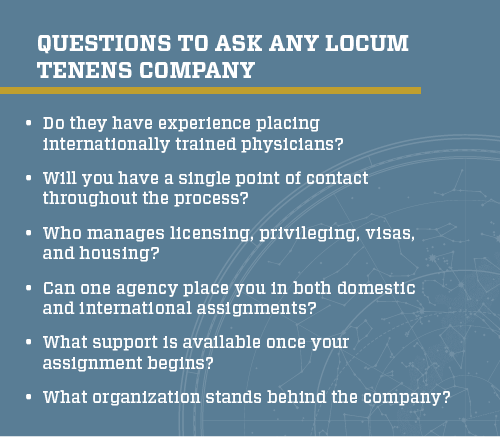
Eight questions to ask before you choose a locum tenens company—and how we've got you covered.

Will I have one point of contact?
Yes, each physician has a dedicated recruiter who works with you from your first call through each assignment. Domestic and international recruiters share what they know about you, and 24/7 support is available before, during and after each assignment.

Can the company place me where I want to work?
Assignments range from week-long domestic placements to international placements that typically run six months to a year or longer, in destinations including New Zealand, Australia, the Pacific Islands, the Caribbean, and Canada.

Who handles licensing, privileging and credentialing?
GMS team members have specific roles with expertise in each area, and the company has helped thousands of physicians with visas, licenses and privileges. Working with one company for domestic and international assignments also means fewer repeat submissions.

Who arranges housing, travel and visas?
GMS typically handles travel, transportation, and housing through partners with housing expertise, or provides a stipend if you prefer to book your own. We also help with visas for you and the family who travels with you, and can point you toward help with school enrollment and cell phone plans.

What happens when my assignment ends?
Because GMS offers both domestic and international assignments, a domestic assignment can be lined up before you return home, so you are not left looking for work when you get back. It works in the other direction too, since GMS can place you in a short domestic assignment first if there is lead time before an international assignment begins.

What support is there during the assignment?
GMS offers 24/7 support before, during and after each assignment, so you can reach someone to troubleshoot challenges at any hour. Your recruiter also stays in touch with you throughout, and many physicians keep in contact with their recruiters long after an assignment ends.

What do physicians say about the company?
GMS has earned the ClearlyRated Best of Staffing Talent Award for four consecutive years, and the award is based entirely on survey feedback from the physicians the company places. Fewer than 2% of staffing agencies in the U.S. and Canada earn this distinction.

Is malpractice coverage included?
International contracts usually include malpractice coverage, and GMS and your facility support you if something happens. Coverage terms are set before each assignment, so your recruiter can confirm what is included before you accept, and you can read more about how malpractice works in other countries.
What to expect when you work with GMS
Step 1: Talk with a dedicated recruiter
Your first conversation is with a recruiter who will work with you throughout the process. Each GMS physician has a recruiter who paints a picture of the facility's culture and business environment and is honest and transparent about what to expect, so you get a good match for your needs and wants.
Our people get to know you and your story, where you’re going, and what you need.
That relationship tends to last. Many physicians still call, text, or send pictures to their GMS recruiters months or years after an assignment ends.
I have worked with the same recruiters for my assignments, and I have gotten to know them, and they are so good.
Timing starts with that first call. Most international assignments take at least four months from the time you accept a position to your first day, because visas, credentialing, and licensing take time, and many facilities advertise placements six to nine months in advance. GMS is glad to talk with physicians up to a year out to start gathering paperwork and vetting opportunities. Your recruiter can give you realistic timing for a specific opening. For more on planning ahead, see our beginner’s guide to international locum tenens.
Step 2: Get matched to the right assignment
Once your recruiter understands what you want, the focus shifts to finding the right assignment. GMS offers a range of lengths and locations, from week-long domestic assignments to international assignments that typically run six months to a year or longer, so you can find what works for your life.
We’ve spread out the lengths and locations to give physicians a better offering of what works for them, even offering week-long assignments.
Flexibility matters when life changes. Between two assignments in New Zealand, Dr. Dayton had a family medical situation and needed to stay close to home. GMS found her a domestic assignment that fit. Her two New Zealand assignments ran eight months and six months, and her domestic assignment in Idaho followed a schedule of five days on and nine days off. Read her full story.
Step 3: Licensing, privileging, and credentialing
Credentialing is where many physicians feel the most friction. Each facility needs to verify who you are, and working with several companies means repeating the process. Neurologist Dr. Sue Ming describes the typical burden.
You have to send your information to each of them: who you are, licensures, CVs, and letters of recommendation, things like that. That’s a lot of extra work.
Working with a single agency for both domestic and international assignments reduces much of that repetition.
One big advantage of working with one company is that whenever you take a new assignment, there’s a lot of credentialing, and there’s so much paperwork and hassle that goes into it. Because I work with GMS for both international and domestic assignments, that takes a lot of that off my plate.
GMS has helped thousands of physicians with visas, licenses, and privileges, and team members have specific roles with expertise in each area. If your plans involve multiple states, read our guide to interstate medical licensure.
Here is what to expect on paperwork. For international assignments, you will typically provide documents such as your medical and postgraduate training certificates, life support certificates, board certification, current licenses, immunization records, and an updated CV. GMS's standard credentialing, which repeats every two years, asks for three peer references, at least two from your specialty, all from the past 24 months. Some countries are stricter: New Zealand, for example, asks for references who are board certified in your specialty. Your recruiter will tell you what each facility requires. Our guides to physician references and practicing medicine overseas cover the details.
Step 4: Housing, travel, and visas
For international assignments especially, logistics can feel like the biggest hurdle. GMS works with partners who have expertise in housing and arranges accommodations for physicians, or provides a stipend if you prefer to book your own. For physicians who travel with family, that support extends further.
GMS also helps with visas for you and the family members who travel with you, can point you to help with school enrollment and cell phone plans, and helps international physicians set up bank accounts.
Dr. Dayton prefers to travel with her family. When she worked in New Zealand, GMS helped with housing and visas for her wife and daughter and supported her wife in obtaining a work visa. She says she prefers working with GMS because of the support and assistance they have given her and because they have made locums easy.
We make all of this easy for doctors. There’s a fair amount of trepidation that comes with this type of work. Our job is to minimize those worries and provide an outstanding experience all the way through.
Browse the international resources page for destination details, read our guide to locum tenens housing, or see what to know about housing in New Zealand or housing guidance.
Step 5: Your first assignment and ongoing support
When your assignment starts, you are not on your own. You have your recruiter, and support is available before, during, and after each assignment, including 24/7 help if something comes up. Physicians on longer international assignments of nine to 12 months also get time to live like a local, with vacation time built in.
For many of our physicians, it’s not just about the financial aspect of making money; it’s about their complete experience, from opportunities to travel to fully using their medical skills to bonding with their patients and the community.
After the assignment: Domestic work between international placements
A common worry about international locum tenens is what comes next. Physicians who leave for several months may not know what they will do when they return. Because GMS offers both domestic and international assignments, you can plan the next step before you leave.
“Some physicians may feel uneasy around the transition after an assignment, especially if they don’t have another job waiting for them when they get home," Global Medical Staffing vice president said. "It helps to have an international representative who connects you to somebody you can trust on the domestic side who can put you to work right away.”
“Your domestic assignment can be secured and ready to start as soon as you return home if that’s your plan," Mathis said.
It works in the other direction too. If there is lead time before an international assignment begins, GMS can place you in a short domestic assignment first. Dr. Ming often switches between assignments in Guam and Alaska and plans both well in advance, so there is little to no lapse in work.
For more on locums in the U.S., see our guide to domestic locum tenens.
What sets GMS apart
Putting the steps together, these are the differences physicians point to most.
Built around the international pathway
GMS was founded to cater to international assignments, has placed physicians in New Zealand and Australia since 1994, and has placed thousands of physicians in New Zealand. Being headquartered in the U.S. means the team understands U.S. physicians and the assurances they want before going to a country and a facility they have never seen.
Domestic and international under one agency
GMS is one of the first locum tenens agencies to place physicians internationally, and it offers domestic assignments as well. One agency means one relationship, shared knowledge, and fewer repeated forms.
Hands-on help with international logistics
Facilities that advertise locally usually look for physicians already licensed in their country, and they do not always help with licensing, visas, travel, or housing. GMS has long-standing partnerships with health systems and facilities around the world and walks you through the visa, credentialing, and licensing process, including how malpractice works in each country.
A boutique feel with big company backing
GMS is part of the CHG Healthcare family, which provides the support of one of the largest healthcare staffing companies in the U.S. while maintaining a small-company feel.
We’re small enough to care but have the experience, horsepower, and knowledge to deliver
Personal relationships
Recruiters, housing partners, and credentialing teams share what they know about you, so you do not have to retell your story each time.
A variety of assignments
Domestic and international, short and long, so your options can change as your life does.
A focus on the whole experience
Many GMS physicians are motivated by travel, the opportunity to use their full range of medical skills, and connecting with patients and communities, not only by financial considerations.
Recognition from physicians
In 2026, GMS earned ClearlyRated's Best of Staffing Talent Award for the fourth consecutive year. The award rests entirely on survey feedback from the physicians a firm places, and fewer than 2% of staffing agencies in the U.S. and Canada earn it. Read more about the award or see GMS's ClearlyRated profile.
Frequently asked questions
How does locum tenens work?
Locum tenens means physicians work temporary assignments at facilities that need coverage. With a company like Global Medical Staffing, a recruiter matches you to an assignment, a team handles licensing, privileging, and credentialing, and housing and travel are arranged for you. You work the assignment, then choose your next one.
What is locum tenens staffing?
Locum tenens staffing is when a company places physicians in temporary positions at hospitals and clinics that need extra coverage. The company finds the assignment, manages paperwork such as licensing and credentialing, and supports the physician before, during, and after the assignment, so facilities stay staffed and physicians can work flexibly.
How do I choose a locum tenens company?
Ask whether you will have one recruiter who knows you, who handles licensing, credentialing, housing, and visas, whether the company offers the assignment types you want, and what support looks like during the assignment. If you want domestic and international work, look for an agency that can handle both.
What is the credentialing process for locum tenens?
Credentialing is how a facility verifies your qualifications before you start. You typically provide your CV, licensure details, and professional references, and the facility reviews them. Working with one company means you avoid sending the same documents to several companies. Your recruiter will tell you what each facility requires.
Can I work domestic and international locums with one agency?
Yes. With Global Medical Staffing, international and domestic recruiters share what they know about you, so you do not have to retell your story. A domestic assignment can be secured before you return from abroad or, if there is lead time, before an international assignment begins.
Does GMS help with housing and visas?
Yes. GMS has partners with housing expertise who arrange accommodations, and the company has helped thousands of physicians with visas, licenses, and privileges. Dr. Elizabeth Dayton says GMS helped with housing and visas for her family in New Zealand. Your recruiter will explain what applies to your destination.
How long does it take to start an international locum tenens assignment?
Most international assignments take at least four months from the time you accept a position to your first day, to allow for visas, credentialing, and licensing. Facilities often advertise six to nine months ahead, and the interview process can add a couple of weeks to a month. Talking with a GMS recruiter up to a year out gives you time to gather paperwork. See the beginner’s guide to international locum tenens for more.
What makes GMS different from other locum tenens companies?
GMS places physicians on both domestic and international assignments, so one recruiter team and one set of paperwork can follow you from assignment to assignment. It specializes in international placements, offers 24/7 support, and is part of the CHG Healthcare family while keeping a small-company feel. Physicians also rate GMS highly: ClearlyRated has awarded it the Best of Staffing Talent Award for four consecutive years.
Does GMS cover malpractice insurance?
International locum tenens contracts usually cover malpractice insurance, and GMS and your facility support you if something happens. Coverage terms are set before each assignment, so confirm what is included with your recruiter before you accept. Our guide to how malpractice works in other countries explains the differences.
Next step: Talk with a GMS recruiter
If you are weighing locum tenens companies, the quickest way to see whether GMS is the right fit is to talk with a recruiter. Explore current opportunities in New Zealand or the United States, browse all locum tenens jobs, or learn more about GMS.
Ready for your first (or next) locum tenens assignment? Give us a call at 1.800.760.3174 or view today's job opportunities.